

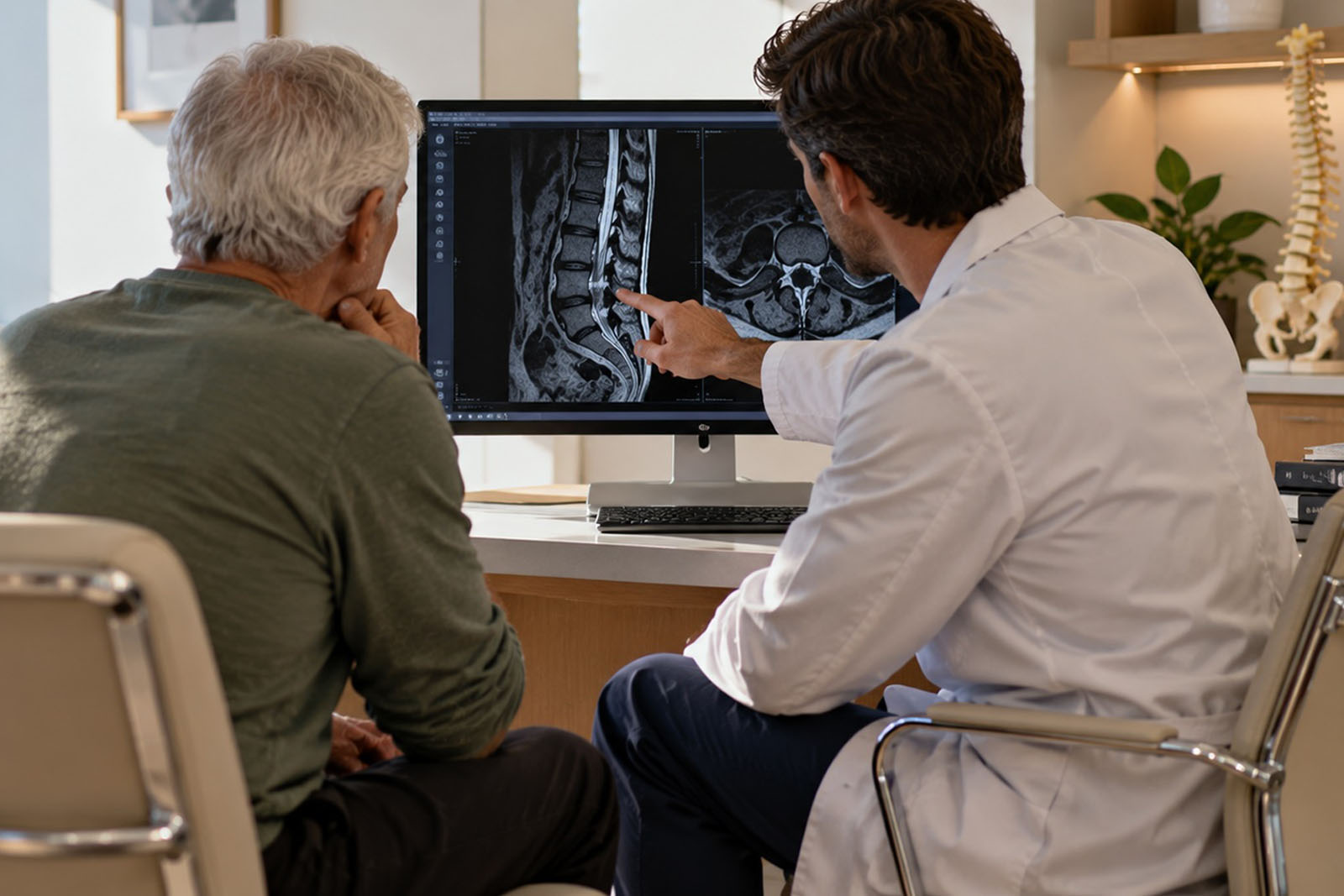
A thoracic disc herniation develops in the middle portion of the spine, between the neck and lower back. Although less common than a cervical or lumbar disc herniation, it can cause symptoms that are difficult to recognize, including mid-back pain, pain that wraps around the ribs or abdomen, and numbness or tingling across the torso. If the disc compresses the spinal cord, it may also affect balance, walking, leg strength, or bowel and bladder control.
Because these symptoms can resemble heart, lung, gastrointestinal, or other spinal conditions, an accurate diagnosis requires more than an imaging finding alone. Dr. Todd Lanman evaluates the patient’s symptoms, neurological examination, and imaging together to determine whether a thoracic disc herniation is the likely source of the problem and whether treatment is necessary.
What Is a Thoracic Disc Herniation?
The thoracic spine extends from the base of the neck to the lower rib cage and contains 12 vertebrae separated by cushioning discs. Each disc has a firm outer layer surrounding a softer, gel-like center. A thoracic disc herniation occurs when part of the inner material pushes through a weakened or torn area of the outer layer.
Some thoracic disc herniations cause no symptoms and appear incidentally on imaging. Others irritate a thoracic nerve root, which may cause pain, numbness, or tingling that wraps around the ribs, chest, or abdomen. A larger or centrally located herniation may compress the spinal cord and affect leg strength, balance, walking, or bowel and bladder function.
The presence of a herniated disc on an MRI does not by itself prove that it is the source of a patient’s symptoms. Diagnosis depends on whether the location of the disc abnormality matches the patient’s symptoms, neurological examination, and other imaging findings.
Thoracic Disc Herniation Symptoms
Symptoms depend on the location of the herniation, whether it affects a nerve root or the spinal cord, and the degree of compression. Some thoracic disc herniations cause no symptoms at all.
Possible symptoms of thoracic disc herniation include:
- Mid-back pain
- Burning, tingling, numbness, or shooting pain that wraps around the ribs, chest, or abdomen
- A band-like feeling of pressure around the torso
- Leg weakness, heaviness, stiffness, or numbness
- Difficulty walking, poor balance, frequent tripping, or falls
- Increased muscle tightness or spasms in the legs
- Changes in bowel or bladder control in severe cases
Pain and sensory changes around the chest or abdomen usually reflect thoracic radiculopathy (irritation of a thoracic nerve root). Leg symptoms, balance problems, and walking difficulty may suggest thoracic myelopathy (spinal cord dysfunction), which requires prompt evaluation.
Because thoracic disc symptoms can resemble heart, lung, gastrointestinal, kidney, rib, or muscular conditions, new chest or abdominal pain should not automatically be attributed to the spine.
What Causes a Thoracic Herniated Disc?
A thoracic disc may herniate as the outer layer weakens with age and degeneration. Trauma, repetitive twisting, heavy lifting, altered spinal alignment, or an underlying structural predisposition may also contribute. Some thoracic herniations become calcified, which can make them more rigid and more difficult to treat.
In many cases, however, there is no single identifiable cause. A disc may deteriorate gradually over time, and a routine movement or minor strain may simply bring previously silent symptoms to attention.
How Is It Diagnosed?
Diagnosis begins with a review of the patient’s symptoms, medical history, and any changes in strength, sensation, balance, walking, or bowel and bladder function. A neurological examination may assess muscle strength, reflexes, sensation, coordination, and gait for signs of nerve-root irritation or spinal cord dysfunction.
MRI is usually the primary imaging study because it shows the disc, nerve roots, spinal cord, and surrounding soft tissues. A CT scan may provide additional detail about calcification, bone anatomy, or the size and position of the herniation. CT myelography may be considered when MRI cannot be performed or does not provide enough information.
Because thoracic disc abnormalities may appear on imaging without causing symptoms, diagnosis requires correlation between the scan, the neurological examination, and the patient’s pain pattern. The evaluation may also need to rule out heart, lung, gastrointestinal, kidney, rib, vascular, infectious, or other spinal conditions that can cause similar symptoms.
When Does a Thoracic Disc Herniation Need Treatment?
Not every thoracic disc herniation requires active treatment. The decision depends on the severity and duration of symptoms, the neurological examination, the degree of nerve or spinal cord compression, and how much the condition limits daily life. Imaging findings matter, but they should be interpreted alongside the patient’s symptoms and examination rather than used alone to determine treatment.
When Conservative Care May Be Enough
Nonsurgical care may be appropriate when pain is mild or manageable, symptoms remain stable, and there is no progressive weakness, walking difficulty, or clinical evidence of spinal cord dysfunction. Treatment may include temporary activity modification, medication, carefully guided physical therapy, and observation.
Some patients improve as inflammation decreases and irritated tissues recover, even though the disc abnormality may remain visible on imaging. Follow-up remains important, particularly when imaging shows contact with or compression of the spinal cord, because new neurological symptoms may change the treatment plan.
When Surgery May Be Considered
Surgical evaluation may be appropriate when symptoms persist despite a reasonable course of conservative care or when the herniation causes significant nerve or spinal cord compression. Surgery may also be considered for:
- Progressive leg weakness, stiffness, or numbness
- Increasing difficulty with balance or walking
- Frequent tripping or falls
- Persistent, disabling chest, rib, abdominal, or mid-back pain
- Worsening signs of thoracic myelopathy (spinal cord dysfunction)
- New bowel or bladder changes
- A large or calcified herniation that creates substantial pressure on the spinal cord
The decision does not depend on the size of the herniation alone. Its location, degree of calcification, effect on the spinal cord, rate of neurological change, and the patient’s overall health all influence whether surgery is appropriate.
When to Seek Urgent Medical Attention
New or rapidly worsening leg weakness, inability to walk safely, sudden loss of balance, numbness in the groin or saddle region, or loss of bowel or bladder control requires urgent medical assessment. Severe back pain after major trauma, or pain accompanied by fever, unexplained weight loss, a history of cancer, or immune suppression, also warrants prompt evaluation because another serious condition may be responsible.
Thoracic Disc Herniation Treatment Options
Treatment should match the patient’s symptoms, neurological findings, and imaging rather than the presence of a herniated disc alone. Some patients improve with nonsurgical care, while others require surgery to relieve pressure on a nerve root or the spinal cord.
Nonsurgical Treatment
Nonsurgical care may be appropriate when symptoms are manageable and there is no progressive neurological decline or clinical myelopathy (spinal cord dysfunction). Options may include:
- Temporary activity modification
- Anti-inflammatory or pain medication
- Carefully guided physical therapy
- Posture, movement, and body-mechanics adjustments
- Targeted spinal injections in selected patients with nerve-root pain
- Clinical follow-up to watch for new weakness, balance problems, or walking difficulty
Injections may reduce inflammation and pain in selected cases, but they do not remove the herniated disc or relieve significant spinal cord compression. They are not a substitute for surgical evaluation when neurological symptoms progress.
Surgical Treatment
Disc herniation surgery may be considered when pain remains disabling despite conservative care, when neurological function worsens, or when the herniation significantly compresses the spinal cord. The goals are to remove the disc material that causes pressure and protect or restore neurological function.
The surgical plan may include:
- Removal of the herniated disc material
- Decompression of the spinal cord or affected nerve root
- Stabilization or fusion when decompression would otherwise create instability
- An approach selected according to the disc’s location, size, consistency, and degree of calcification
Fusion is not necessary in every case. It may be recommended when the procedure requires removal of stabilizing structures, when instability or deformity is already present, or when the anatomy makes added support necessary.
Thoracic disc surgery requires careful planning because the spinal cord lies directly behind the disc. A soft, lateral herniation may allow a different approach than a large, central, or calcified herniation. For that reason, no single operation is appropriate for every patient.
FAQs About Thoracic Disc Herniation
Can a thoracic herniated disc cause chest or rib pain?
A thoracic herniated disc can cause chest or rib pain when it irritates a nerve that travels around the torso. The pain may feel sharp, burning, or band-like and may extend from the mid-back toward the chest or abdomen.
Can a thoracic disc herniation heal without surgery?
A thoracic disc herniation can improve without surgery when symptoms are mild and no progressive neurological problems are present. Selective rest, medication, physical therapy, and time may reduce pain and inflammation, although the disc abnormality may remain visible on imaging.
Is a thoracic herniated disc serious?
A thoracic herniated disc can be serious if it compresses the spinal cord. Warning signs include leg weakness, stiffness, balance problems, difficulty walking, or bowel and bladder changes. Many smaller herniations, however, cause mild symptoms or no symptoms at all.
When is thoracic disc surgery necessary?
Thoracic disc surgery may be necessary when spinal cord compression causes progressive weakness, walking difficulty, balance problems, or bowel and bladder changes. It may also be considered when severe pain persists despite appropriate nonsurgical treatment and the imaging findings match the symptoms.
Can a thoracic disc herniation affect the legs?
A thoracic disc herniation can affect the legs if it compresses the spinal cord. Possible symptoms include weakness, numbness, stiffness, heaviness, poor balance, frequent tripping, or difficulty walking. These symptoms may indicate thoracic myelopathy and should receive prompt medical evaluation.
Can a thoracic disc herniation be found by accident?
A thoracic disc herniation can be found by accident on imaging performed for another reason. Many thoracic herniations cause no symptoms, so treatment is not based on the scan alone. Doctors compare the imaging with the patient’s symptoms and neurological examination.
Schedule an Evaluation With Dr. Todd Lanman
Thoracic disc herniation symptoms can resemble heart, lung, gastrointestinal, rib, muscular, and other spinal conditions. An accurate diagnosis therefore requires more than the presence of a disc abnormality on an MRI. The patient’s symptoms, neurological examination, and imaging must be considered together to determine whether the herniation is the likely source of the problem and whether treatment is necessary.
Dr. Todd Lanman evaluates thoracic disc herniations with close attention to spinal cord function, disc location, calcification, and the patient’s daily limitations. To discuss your symptoms and treatment options, schedule a personalized consultation with Dr. Lanman.