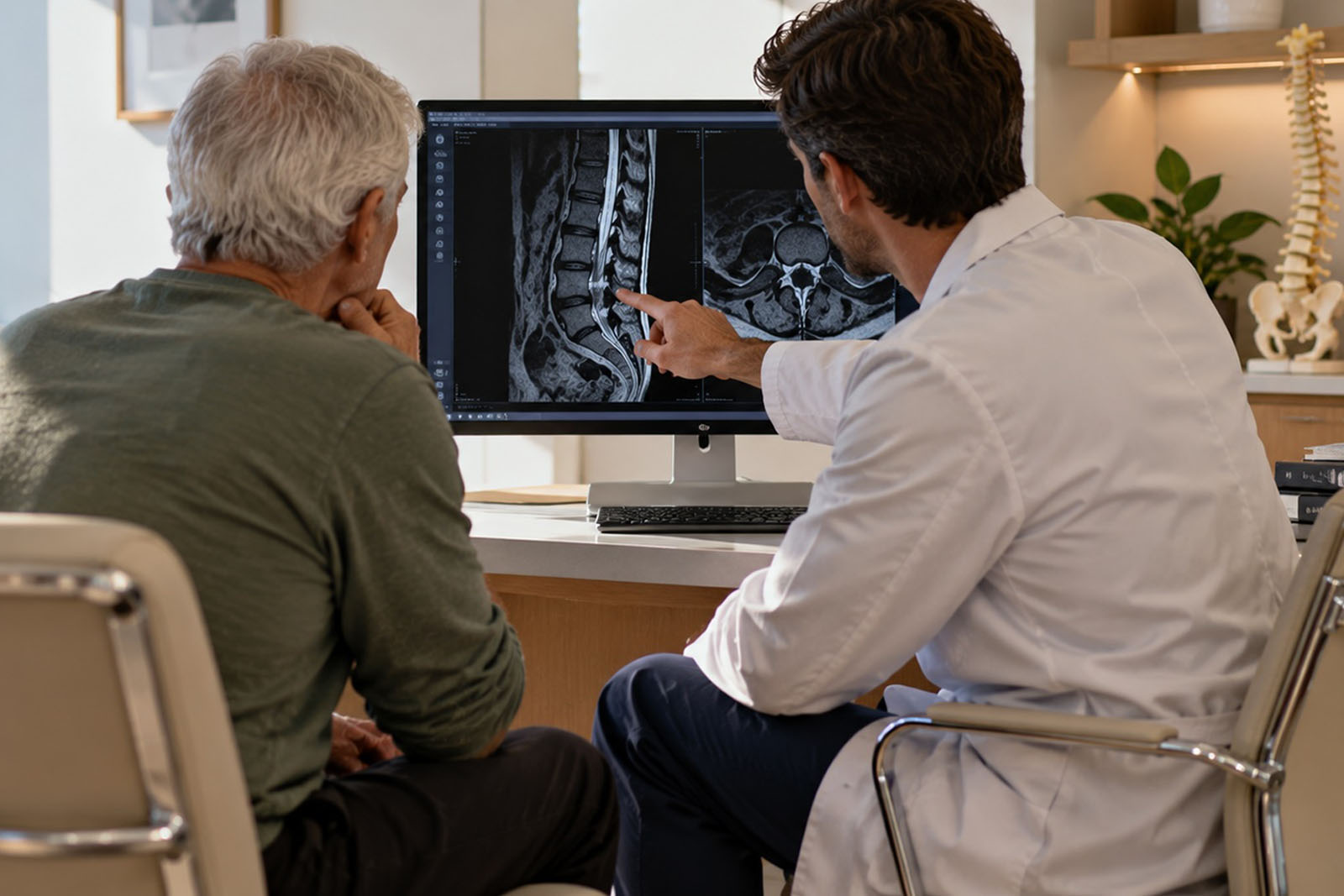


When an MRI report says that a herniated disc is “touching,” “contacting,” or “abutting” a nerve, it means that displaced disc material has reached or come into contact with a nearby nerve root as it exits the spine. These terms describe the relationship seen on the MRI, but they do not establish that the nerve is damaged or severely compressed.
The importance of this finding depends on whether the nerve is irritated and whether the location of the herniation matches the patient’s symptoms. A disc may touch a nerve without causing pain, while even modest contact may produce significant symptoms if inflammation affects the nerve.
Dr. Lanman therefore considers the level and side of the herniation together with the pattern of pain, numbness, tingling, weakness, reflex changes, and other examination findings. This helps determine whether the MRI finding is incidental or is the likely cause of the patient’s symptoms.
What Is a Herniated Disc?
The discs between the bones of the spine act as cushions and help the spine move. Each disc has a soft center surrounded by a tougher outer layer. A herniated disc occurs when some of the disc material moves through a weakened or torn area in the outer layer and extends beyond its normal position.
A herniated disc can occur in the cervical spine, or neck, or in the lumbar spine, or lower back. The displaced disc material may remain close to the disc and cause few or no symptoms. In other cases, it may move into the space where a nearby nerve travels and irritate, inflame, or compress the nerve.
Several factors can make a disc more likely to herniate. These include age-related changes, repeated bending, lifting, or twisting, and a sudden injury or strain. A herniation may also develop as part of degenerative disc disease, in which a disc gradually loses water, flexibility, and strength over time.
What Does It Mean When the Disc Touches a Nerve?
When an MRI report says that a herniated disc is “touching,” “contacting,” or “abutting” a nerve, it usually means that displaced disc material has reached the nerve root as it exits the spine. These terms describe what the radiologist sees on the image. They do not, by themselves, prove that the nerve is damaged or severely compressed.
Some people have disc material that touches a nerve but experience little or no pain. Others develop symptoms when the nerve becomes irritated, inflamed, or compressed. Even relatively modest contact may cause significant discomfort if inflammation affects the nerve, while a more noticeable finding on an MRI may cause few symptoms in another person.
For this reason, the most important question is not simply whether the disc touches the nerve, but whether the MRI finding explains the patient’s symptoms. The level and side of the herniation should correspond with the pattern of pain, numbness, tingling, weakness, or reflex changes found during the neurological examination. Treatment decisions should reflect this complete clinical picture rather than one phrase in the MRI report.
Symptoms That May Happen When a Disc Irritates a Nerve
When a herniated disc irritates or compresses a nerve root, symptoms may follow the path of that nerve into an arm or leg. This is called radiculopathy (pain or other neurological symptoms caused by an affected spinal nerve root). Symptoms vary according to which nerve is involved and how severely it is affected.
Common symptoms may include:
- Pain that travels into the arm or leg
- Numbness or tingling
- Burning or electric shock-like pain
- Muscle weakness
- Pain that worsens with certain movements or positions
When the herniated disc is in the neck, symptoms may extend into the shoulder, arm, hand, or fingers. When the herniation is in the lower back, symptoms may travel through the buttock and into the leg, foot, or toes. Not every patient experiences all of these symptoms, and symptom severity does not always reflect the size of the herniation seen on an MRI.
Is a Disc Touching a Nerve Serious?
A disc touching a nerve is not necessarily serious. Mild contact may cause no symptoms, and many patients with stable symptoms improve with time, temporary activity changes, physical therapy, medication, or other nonsurgical care. The MRI wording alone does not determine the severity of the condition. What matters is whether the nerve is irritated or compressed and whether the patient has pain, loss of sensation, weakness, or impaired function.
Symptoms that warrant prompt evaluation include:
- Severe or persistent pain that travels into an arm or leg
- Increasing numbness or tingling
- New or progressive muscle weakness
- Loss of hand coordination or difficulty with fine movements
- New balance problems or changes in walking
Some symptoms may indicate severe compression of the spinal nerves or spinal cord and require immediate emergency evaluation. These include new difficulty urinating, loss of bladder or bowel control, numbness around the groin or inner thighs, or rapidly worsening weakness. Although these complications are uncommon, prompt treatment may help prevent permanent nerve damage.
How Dr. Lanman Evaluates Herniated Disc and Nerve Symptoms
Dr. Lanman does not rely on the wording of an MRI report alone. He reviews the actual images to assess the location and size of the herniation, the condition of the affected disc, the degree of nerve compression, and the overall alignment of the spine.
The evaluation may include:
- A detailed review of where the pain begins and how it travels
- Questions about numbness, tingling, weakness, and changes in daily function
- A neurological examination
- Tests of muscle strength, reflexes, sensation, balance, and coordination
- Review of MRI scans and other imaging studies
- A discussion of prior treatments and the patient’s response to them
The key question is whether the imaging findings match the patient’s symptoms and examination. By combining these findings, Dr. Lanman can determine whether the herniated disc is truly responsible for the symptoms and whether the patient is most likely to benefit from observation, nonsurgical treatment, or surgery.
Treatment Options for a Herniated Disc Touching a Nerve
Treatment for a herniated disc depends on the severity of the symptoms, the degree of nerve involvement, and whether the condition affects strength or function. Options range from nonsurgical care to surgery when symptoms persist or neurological problems develop.
Non-Surgical Treatment
When symptoms are stable and there is no progressive weakness or other urgent neurological problem, many patients begin with nonsurgical care. The goal is to reduce pain and inflammation, protect the affected nerve, and help the patient return to normal activity.
Treatment may include:
- Physical therapy to improve strength, flexibility, posture, and movement
- Anti-inflammatory medication when appropriate and medically safe
- Temporary activity modification to avoid movements that worsen symptoms
- Spinal injections to reduce inflammation around the affected nerve
- Time and guided monitoring to assess whether symptoms continue to improve
Many herniated disc symptoms improve without surgery. However, Dr. Lanman may adjust the treatment plan if pain persists, weakness develops, or the patient’s function declines.
Surgical Treatment
Surgery may be considered when nerve compression causes persistent radiating pain, progressive weakness, or loss of function despite appropriate nonsurgical care. The recommended procedure depends on the location of the herniation, the degree of nerve compression, the condition of the disc, and the overall structure of the spine.
In some patients, surgery may simply remove the portion of the disc that presses on the nerve or enlarge the space around the nerve. In others, the damaged disc may require reconstruction. Artificial disc replacement may be appropriate for carefully selected patients when the disc itself is a major source of the problem.
Dr. Lanman emphasizes motion-preserving treatment whenever it is clinically appropriate. By maintaining movement at the treated level, disc replacement may help preserve more natural spinal mechanics and reduce stress on nearby spinal segments.
Get Clarity on Your MRI and Symptoms
A herniated disc that touches a nerve can sound frightening, but the wording in an MRI report does not tell the whole story. The right diagnosis requires a careful review of the images, the pattern of symptoms, and the neurological examination to determine whether the disc is truly affecting the nerve and what treatment, if any, is needed.
Dr. Todd Lanman provides expert evaluation of complex cervical and lumbar disc conditions, with a focus on accurate diagnosis, nerve preservation, and motion-preserving treatment whenever appropriate. If you have pain, numbness, tingling, weakness, or questions about an MRI report, schedule a consultation for a personalized review of your symptoms, imaging, and treatment options.